Training guide
Texas Hold'em Practice Rules
Practice table rules, room conduct, and safety boundaries for Let's poker Texas Hold'em sessions.
Table-flow descriptions follow the current practice-room implementation.
Practice Table Purpose
Let's poker rooms simulate Texas Hold'em for learning, entertainment, and review. The platform is not a casino, sportsbook, gambling product, financial service, tournament organizer, or settlement tool.
Every table should be used as a training environment. Players can practice hand selection, position, bet sizing, pot control, bluff selection, showdown review, and table communication without assigning real-world value to the result.
Table Flow
Players sit at available seats, receive hole cards, act in turn, and review the result after showdown or when all other players fold. Depending on room settings, a session may include practice blinds, practice stacks, action timers, chat, spectators, AI opponents, and recorded hand history.
The table flow is designed to mirror common Texas Hold'em decision points while keeping the outcome educational. A lost or won practice pot is only a training event, not a financial result.
Player Conduct
Use respectful nicknames, room names, chat, and voice behavior. Do not harass, threaten, bully, impersonate, spam, publish personal information, share illegal content, evade moderation, attack the service, exploit bugs, or interfere with other players' practice.
Room hosts should set expectations before a session begins. If the table is for beginners, coaching, a single topic, or a private study group, make that clear in the invitation so players understand the practice purpose.
Prohibited Gambling Use
Do not use Let's poker to arrange, advertise, track, record, or settle real-money gambling. This includes cash games, prize pools, side payments, debts, staking, swaps, chip sales, account sales, paid seats, external payment links, gambling affiliates, or offline settlement based on room results.
This prohibition applies to room names, chat, voice, profiles, reports, rankings, screenshots, exported records, and external links shared through the service.
Training Records
Hand history and reports are training records only. They may help players review decisions and may help moderators investigate misuse. They do not prove winnings, losses, debt, credit, property rights, skill rankings for prizes, or any financial obligation.
If a player uses records to pressure another person for payment or settlement, report the issue to support with the room code, hand ID, nickname, timestamp, and any relevant context.
Safe Practice Checklist
Before playing, confirm that everyone understands the session is practice-only. During play, keep chat focused on learning and table decisions. After play, review hand records for strategy, not for assigning value. If a room stops feeling safe or practice-focused, leave the room and report the concern.
Example: A Legal Action Sequence
At 10/20 blinds, a player opens to 60 and the next player raises to 180. A player who has not invested chips on that street may fold, call 180, or make a legal re-raise if the stack and minimum-raise rule allow it. They cannot check because a bet is outstanding. The exact buttons shown by Let's poker are derived from the authoritative hand state.
Room-Host Checklist
- Use a neutral room name that does not mention cash, prizes, payment apps, or settlement.
- Explain the training topic before starting.
- End or report abusive behavior rather than negotiating through chat.
- Close an inactive room instead of leaving an empty public listing.
- Review completed hands only after private information is no longer live.
Common Mistakes
Common mistakes are treating the host as able to override poker rules, discussing folded private cards while a hand is still active, and using practice-chip changes as a debt record. None of those uses are supported.
Product Reference
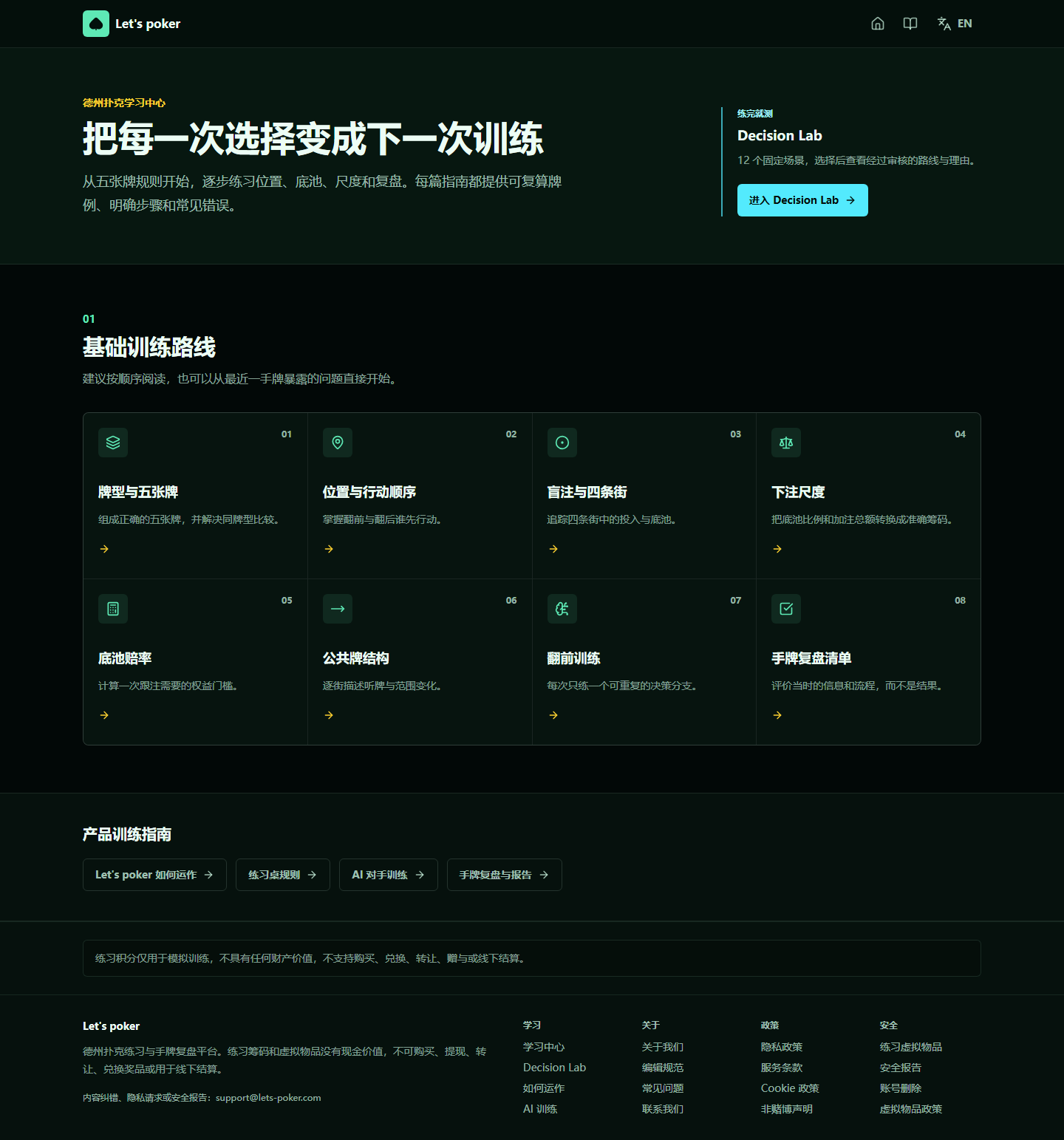
Rules, product instructions, and decision practice are linked from one public learning center.