Training guide
AI Opponent Training Guide
How to use the Let's poker AI opponent for focused heads-up Texas Hold'em practice.
Instructions were checked against the current heads-up AI practice flow.
AI Practice Purpose
The Let's poker AI opponent is designed for heads-up Texas Hold'em practice. It gives a player a fast way to rehearse decisions, compare lines, review tempo, and build confidence before joining a friend room.
AI practice is most useful when you choose one training goal before the session starts. Examples include preflop discipline, blind defense, continuation betting, turn pressure, bluff selection, thin value betting, showdown review, or staying patient through repeated folds.
What the AI Does
The AI sits across from you at a practice table and takes simulated poker actions. It creates repeatable decision spots so you can focus on the hand, the board, the pot, and the action history.
The AI does not create gambling value, financial advice, guaranteed strategy, professional coaching, real-world winnings, or reliable predictions of how every human opponent will play. It is a learning partner, not an authority.
How to Run a Focused Session
Start with a short session and a single question. For example: "Am I defending the big blind too wide?", "Am I betting the turn without a clear reason?", or "Do I understand why I called river?" Play a small number of hands, then review the action history instead of immediately starting another long session.
After each marked hand, compare your actual decision with the plan you had before the street began. If the hand reached showdown, review the board texture and the final hand type. If the hand ended before showdown, review what information was available when the final action happened.
Reading the Results
Practice outcomes can be noisy. A good decision may lose a simulated pot, and a weak decision may win one. The useful training signal is the reasoning you can reconstruct after the hand: position, stack depth, pot size, board texture, previous action, and whether your line made sense.
Use reports to identify repeat patterns instead of judging one hand in isolation. If the same mistake appears across multiple hands, turn it into the next session goal.
Limits and Safety
AI responses and practice outcomes can be incomplete, imperfect, or different from human behavior. Do not use AI practice results to advertise gambling, track debts, settle payments, assign value to chips, or claim guaranteed poker skill.
Practice chips, rankings, reports, and AI session results have no cash value and cannot be redeemed, transferred, sold, gifted, exchanged, loaned, staked, or settled offline.
Worked Training Prompt
At 10/20, you open the button to 50 with A♦ 8♦ and the AI big blind calls. The flop is K♣ 8♠ 3♥. Before acting, state the purpose of each candidate: a small bet may receive calls from weaker pairs or deny overcard equity; a check may preserve showdown value and avoid building a larger pot with middle pair. The exercise is to compare reasons, not to memorize one answer.
Ten-Hand Protocol
- Pick one topic, such as middle-pair flop decisions.
- Play ten hands without changing the topic after a loss.
- Mark every hand where you could not state a value target or bluff target.
- Review those decisions before starting another set.
- Compare the repeated pattern with your personalized training prompts.
Common Mistakes
Common mistakes include trying to “beat the AI” instead of testing a decision, changing the goal after every result, and assuming the AI represents every human player. A useful session produces a clearer next question even when the practice-chip result is negative.
Product Reference
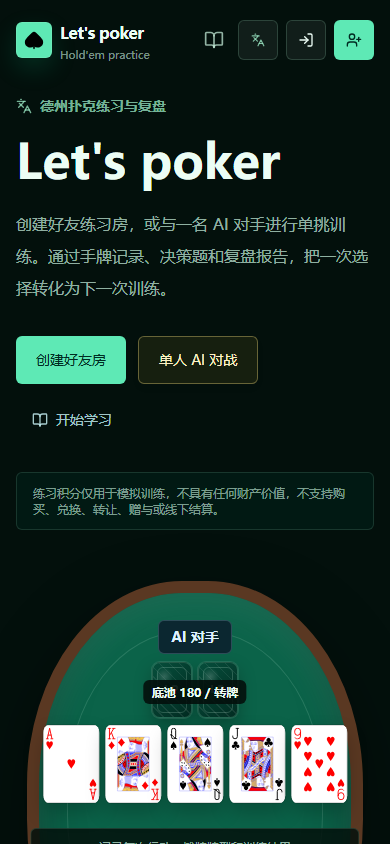
The AI route is presented as a practice action beside friend rooms and learning, not as a wager or prize game.